Author claims the system setting "Privacy & Security > Apple Intelligence Report > Report Duration" with its 3 options [Off | 15 minutes | 7 days] sends that data to Apple with that frequency. This is wrong - this is a transparency report so that you as a user can see everything that is getting sent to Apple as a part of Apple Intelligence. Nothing additionally is getting sent to apple if you switch this away from "Off".
It's placed right next to a similar report for the user to see which apps generally connect to the internet and to which domains.
Basically, the main point of the article, "I discovered that macOS 15.3 had enabled a feature that was phoning home every 15 minutes with personal data" is not true.
that refers to a post from 2025 that he links to. this is clear from the first sentence of the article. I suspect maybe you didn't actually read the article and spent more time writing this erroneous comment than you might have reading the article.
This is literally the main point of the article:
"The nice thing about keeping a blog is that I can say at precisely 9:51am, Wednesday 5th February 2025, I discovered that macOS 15.3 had enabled a feature that was phoning home every 15 minutes with personal data. And that I said “no” and turned it off."
Disappointing that we have multiple 10-deep reply chains pearl-clutching Apple's disrespect for the user, and no one actually bothered to verify the premise of the article. They just want to be mad.
When I updated, I had to actively sign up for new Siri and even make space for it. Until update, my phone had the "old" Siri. Not sure what the issue is
Snowden got into action because he believed that the US was fundamentally good and needed to get back on track. Over the past 12 years, in the US and around the world, this belief completely vanished. Whatever remains in the archive no longer holds any valuable news.
That doesn't equate. Something can have no value as news but incredible value as security. Your passwords, for example.
The big question is whether Snowden's original thesis - that these newsagencies would find the right balance - was correct. In some ways, I hope there is a complete leak of the archive in decades' time when the relative risk is minimised so that the public can, in turn, evaluate the press of the day as to their ability to do this assessment. It may inform future similar whistleblowers whether Snowden made the right choice.
Example being the gross irresponsibility of Wikileaks releasing unredacted documents that detailed source identities (although all I know about this is anecdata).
The problem here is an information imbalance between seller and buyer.
This could be solved via regulation (unlikely to happen in the US).
Another solution would be independent testing labs / publications. To stay independent, they can't finance themselves using ads. Would people be ok to pay for information, on the internet? For $1000 lawn mower maybe, what about for a $50 kitchen appliance?
This is the same position of Yuval Noah Harari in his recent Economist interview: The ones in power (Musk etc.) try to frame the bad AI future as inevitable, instead of shouldering responsibility. https://www.youtube.com/watch?v=FNZhxTtOL-I
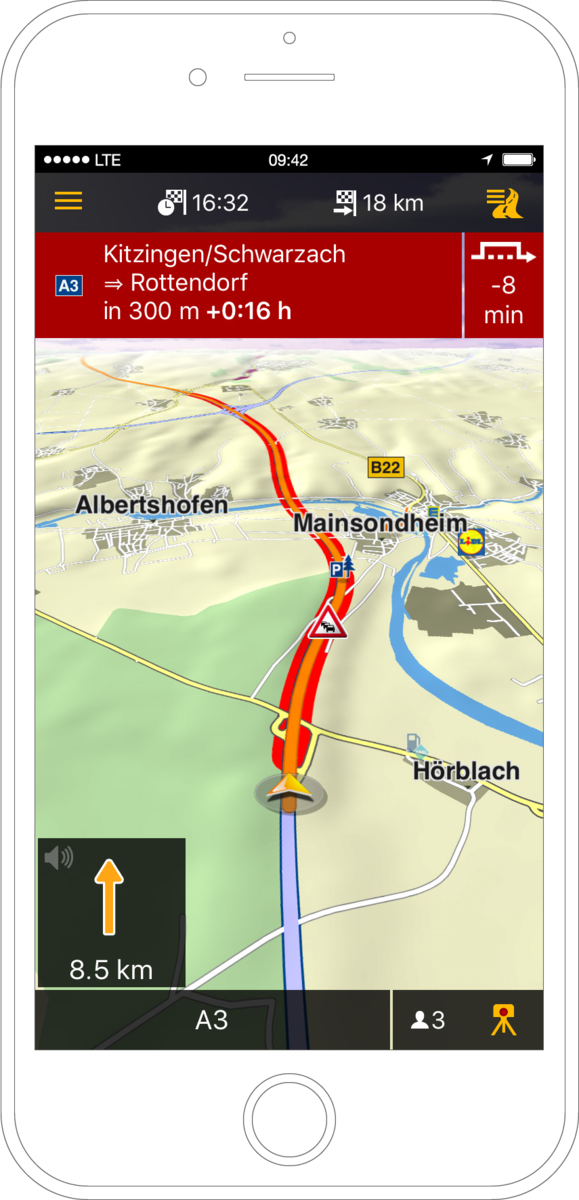
Beautiful perspective if you need to take a left in 500 meters. Not so great if you have to take a left in 3 kilometers because that would just not be visible.
Now of course you could change the parameters so that the upper screen border is 3 kilometers. But normal standard perspective is even better, because it can show you up to infinity. The inherent concept here is that there is a cut-off at the top, and that there is always a lot of unnecessary stuff near you whizzing by to look at / dopamine kicks. So you would have to constantly look at the screen - instead of at the road.
Navigon (among others) back in 2009 showed a perspective that balanced between showing the next junction and the next few kilometers. And leaving out anything unnecessary. I like that better. Example: https://www.notebookcheck.com/fileadmin/_processed_/csm_Garm...
The trick would be adapting relatively, which a lot of apps already do... zoom/flatten out if it's a long stretch of nothing, back in when you start approaching more complicated sections.
The trigger email should obviously go to somebody with more power than a police officer (so that the fear of getting asked ugly questions might slightly intimidate the police officer). Not sure who exactly that somebody would be.


reply