Spore had that but I kind of liked it. I guess that was 20 years ago almost, maybe my standards were lower. It felt charming seeing others' animals, some of them looked pretty cool.
There's a fundamental difference between procedurally generated worlds and how Spore actually works.
The creatures, vehicles, and buildings weren't generated -- they were created
by other players and exchanged asynchronously, then seeded into your
procedurally generated galaxy.
Spore is a Massively Single Player Online Game: no real-time
multiplayer, but your galaxy fills with other people's content.
That's the opposite of the oatmeal problem. Procgen gives you infinite bowls
that all taste the same. Spore gave you a finite but large set of bowls, each made by
someone who cared about it. Different tradeoff, different failure mode -- but
not the one this thread is about.
>[...] Also I want to apologize for the title of this talk in the description, which I know was kind of hopelessly vague.
>What usually happens every year is GDC, they call me up, and they say "we want you to do a talk" and I say okay, and then a week later they say "what's your talk about" and so then I think about it for a while and oh, get a rough idea of what I'm going to talk about, and I give them some kind of generic title in that area.
>That's what usually happens. But this year was different. This year when they asked me what I was going to talk about, I just flat out lied.
>But, so I'm not really going to talk about the future of content. I'm really more in fact going to talk about a possible future of content you know.
>It seems like the theme that I'm coming away from this conference with so far is that the next generation titles are going to be incredibly expensive, we're going to have to build mountains of content, and it's going to drive most of the smaller players out of the market.
>And I'd like to offer potentially an alternate vision of that. You know I think that there is a way to deal with that more creatively. So maybe a more accurate title for this talk would be "What I learned about content from The Sims".
That was 21 years ago. The same argument is being made again right now, with a different machine offered as the answer, and Will's alternative is still the one nobody is trying.
Will's advice for game designers and creative humans in general, from my notes on the talk:
>If you have a weird idea that's so outside of the box, don't forget it. You should go back and revisit your weird ideas later, because you can never know where they might lead to.
In February 2007 PopSci, Will explains the whole design rationale:
>We thought about it. In fact, technically, based on all the stuff we've already done for it, it wouldn't be very hard at all. We've already solved all the hard problems we would need to do a persistent online world version of Spore. The hard part is, what happens when you come to a planet and the planet's offline? Which would be the case. In fact, one of the reasons why I kind of went down this path is that nobody has really explored the hybrid model. And this really is a hybrid, it's what we call a massively single-player game, where we try to get the benefits of an online game, which is all the people building the world collectively together, without the liabilities, which is that the 14-year-old can kill you or that you've invested all this time in your planet and somebody comes along and blows it up, and therefore you had to put everybody on the same level treadmill. And I hate these level treadmill games, and I wanted the players to feel really empowered.
>Here are my notes and summary of the GDC 2005 talk where Will Wright first revealed Spore, which I asked Will to review and check for accuracy. It's interesting to compare the design he described in the talk with what Maxis eventually shipped.
Video of the hour long talk:
>One of the essential problems with designing a Massively Multi Player Online Game like Spore is that players at different levels of the simulation run at different time scales.
>Maintaining time synchronization between players is also the reason The Sims Online doesn't have a "Pause" button or speed controls, or automatically pause in build and buy mode, like The Sims.
>So instead, Spore is a Massively Single Player Online Game. Users don't interact with each other in real time, but instead users can create their own content, and it exchanges that content between users asynchronously.
>That's also how The Sims Exchange lets players asynchronously upload and download their Sims save files along with web pages describing their house, sims, and photo album.
>The Future of Content — Will Wright’s Spore Demo at GDC 3/11/2005
>What I learned about content from the Sims. …and why it’s driven me to procedural methods. …And what I now plan to do with them. Talk by Will Wright, Game Developers Conference, 3/11/2005.
>Based on notes taken by Don Hopkins at the talk, and other discussions and review by Will Wright. The title of the talk “The Future of Content” was purposefully vague, because Will wanted to show Spore in public for the first time, but he had to flat out lie about the title and send a fake set of slides for the EA executives to review, so they didn’t know what he was about to do. A more accurate title for the talk would be “What I Learned About Content from The Sims, and Why it’s Driven Me to Procedural Methods, and What I Now Plan to Do With Them”. [...]
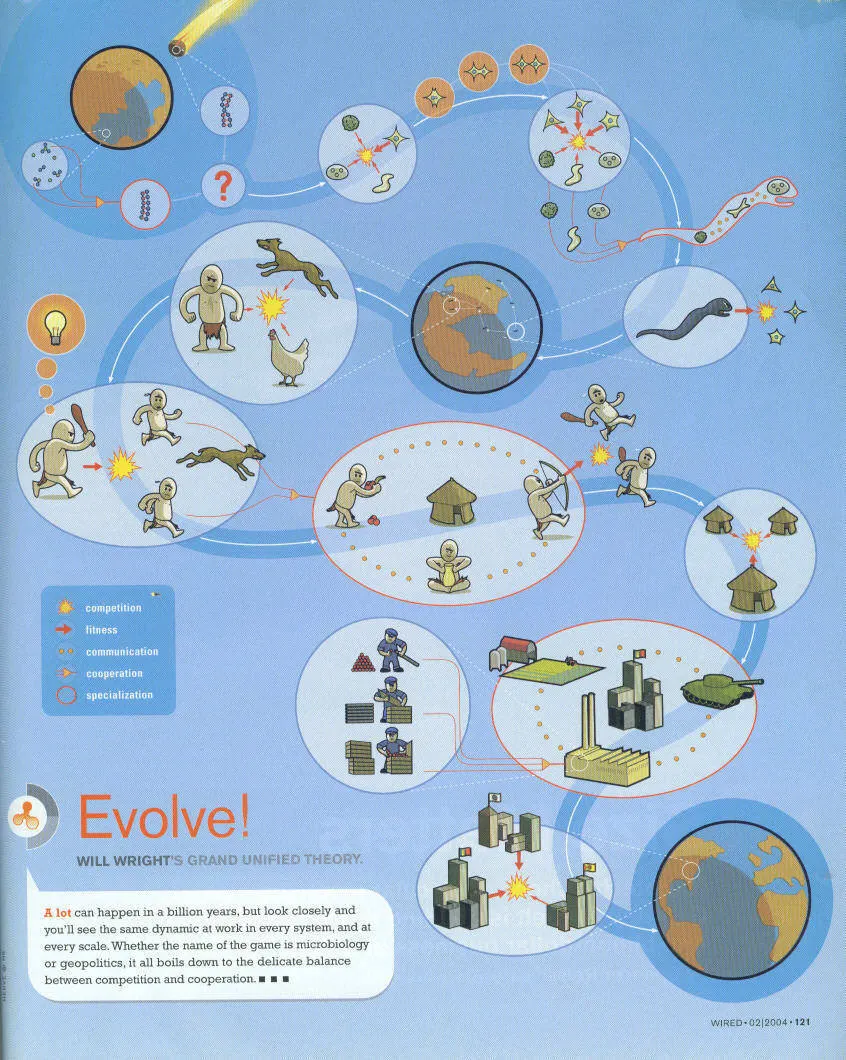
>Wired asked for an illustration to print in the magazine, anything he wanted. So he made a diagram of Spore that Wired published, but he didn’t tell them what it was. The design docs for Spore have been out in Wired Magazine for a year now. (It’s in the Feb 2004 issue of Wired.)
>Will’s Secret Diagram of Spore published in February 2004 Wired:
>And that is the whole point, how you win the game: become involved with the content creation community!
>The powerful but easy to use direct manipulation editor tools, the automatic content sharing system, and the online community around user created content, were together the most innovative and successful things about Spore. (As contrasted with the not as well realized gameplay and storytelling design goals.) [...]
>Of course, these aren’t any old aliens we ask players to invest in — they’re your creation, your aliens. Once you start customizing, and design your creature, emotional investment is generated. It’s magic. Even the ugly ones are loved by their parents. Many games thrive on the interest generated by players’ creative investment. Console role playing games, for example, get this effect when players invest time in equipping and naming characters. I’ve always felt more attached to my characters as I fuss over their outfits and equipment. Creative interaction seems to always generate emotional involvement and attachment. Psychologically, it would seem that part of this stems from the sunk cost fallacy — we become attached to things we’ve invested time and energy into. Of course, it’s not just the hundreds of hours invested in a World of Warcraft character, their relationships, and possessions that generate attachment, it’s the sense that our fabrications are extensions of ourselves. As recipients of our attention and creative energy, our handiworks are reflections of who we are, tangible manifestations of our personalities. It’s no wonder we become attached to what we make, and take the success or failure of our own work and ideas very personally.
>Spore neatly solves the alien attachment problem by asking the player to design them. If a player makes a creature, and it’s appealing, they’ll be quite invested in it. Reflecting on the success of The Sims Exchange, where players shared stories, characters, houses, and objects for The Sims, Will realized that shared creativity would give Spore a broader appeal. Why not build creative exchange into the game, rather than as a website that orbits it? Player created assets are constantly being uploaded and downloaded by Spore, enough material to fill a galaxy. There’s nothing like taking home your latest finger painting, and having mom hang it on the fridge for everyone to see. Sharing not only fills up the galaxy with cool stuff, but allows the entire world to see your fridge, motivating you to continue creating.
>Of course, a lot of deep magic must work properly for something like Spore’s creature creator to function properly. It must be natural to use, easily producing satisfying results for anyone, from beginners to advanced users. And these aliens, lumps of polygons that no animator has ever seen before, must be brought to life. These are rather complicated endeavors, from a design, aesthetic, and technical point of view, but the player should never notice any of it. The game design implications are also challenging — the game must be playable and interesting, regardless of the creatures dropped into it.
But this doesn't look like it's making any new observations. Spore has some 3D modeling tools and abysmal gameplay that could never persuade anyone to start up a game of Spore.
But the models are fun, sure. And other people can find your models, and you can find theirs.
So if we recognize that the "gameplay" part of Spore never worked... we're left with Second Life, a much, much older thing. It hasn't been much of a success.
The comment I pointed you at answers all of this, but you haven't commented on that,
so here it is line by line.
>Spore has some 3D modeling tools
The tools are the least interesting part. The mechanism has a name: Maxis called
it the "Pollinated Content System", and Caryl Shaw's job title was "Pollinated
Content Producer". What she ran was a server, a database schema, and a matching
algorithm that decided which content your galaxy should receive.
The transport isn't a modeling tool either. Creatures compressed to about 3KB,
and every piece of content shipped as a 30KB PNG with the game data embedded
inside the image. You could email a creature. The picture was the data.
>And other people can find your models, and you can find theirs.
No. That is precisely what Spore did not do, and the difference is the subject of
my comment. Nobody finds anything. The server builds a model of your aesthetic
and requests content to match it:
>We're basically building a model of the player's aesthetic. So if you keep
picking things from the shopping catalog that are like super-cute, Disney-like,
then it will start offering you and downloading more stuff that matches your
aesthetic... And when it makes a request to the server it's taking that into
account, so the world will slowly start to represent your aesthetic choices.
Chaim Gingold: "Why not build creative exchange into the game, rather than as a
website that orbits it?" The Sims made you go find things on a website. Spore
made it invisible and automatic. "You can find theirs" describes the version
Spore replaced.
Placement is the hard part, and it is the part you skipped.
>So if we recognize that the "gameplay" part of Spore never worked...
I said so first, in the comment you replied to: the editor, the sharing system
and the community were "the most innovative and successful things about Spore.
(As contrasted with the not as well realized gameplay and storytelling design
goals.)" We agree on the premise and disagree on what follows.
>we're left with Second Life
We are left with its opposite, because you deleted the property that separates
them. Spore is asynchronous: other people's content injected into your private
world by a server that picks it and places it, with nobody else in there. Second
Life is synchronous: one shared persistent world, land you buy, placement you do
by hand.
You can't reach Second Life by removing a feature. You have to add back the one
thing Will designed out, and he gave the reason: "without the liabilities, which
is that the 14-year-old can kill you or that you've invested all this time in
your planet and somebody comes along and blows it up."
Second Life is the control group for the placement problem. Same ingredient,
opposite architecture.
>a much, much older thing
2003 versus 2008: that's just five years, hardly "much, much older".
The genuinely much older ancestors are Lucasfilm's
Habitat in 1986 and LambdaMOO in 1990 for shared worlds, and NetHack bones files
and The Sims Exchange in 2000 for pollination. My point is that you and other
people keep forgetting or never knew the full history.
>this doesn't look like it's making any new observations
My comment's third paragraph says this mechanism has been "reinvented every few
years by people who don't know it has a history or a name." Telling me it's old
is agreement filed as objection, making my point for me.
The observations in there: the matching and placement layer is the invention, not
the editor. Curation comes free, because download counts rank quality better than
a designer can, since thousands of people each pick for their own taste instead
of one person guessing at everyone's. And this keeps dying because nobody is paid
to own it.
>abysmal gameplay that could never persuade anyone to start up a game of Spore
One million copies and 25 million uploaded creations in the first 17 days. 100
million creations by May 2009, averaging 307,000 a day, 31,017,761 of them
creatures, more than 19 times the number of known species on Earth. Two million
copies in three weeks; EEDAR put lifetime sales near 2.8 million, or 3.2 million
counting the Creature Creator.
Spore's TTP (Time To Penis) was negative. The Spore team coined the term, and
Chaim optimized the tools so well that it went negative: players, testers and
"children" were building and sharing penis-shaped creature monsters during the
pre-release beta phase, before the Creature Creator was even officially launched
to the public. The first public use of the term was Margaret Robertson's GDC 2009
talk "SPORE's Wake: What Seriously Happened?", at 38:00, and Engadget wrote it up
the same day:
And the Creature Creator shipped standalone for $10 in June 2008, three months
before the game: an editor sold as a product with no gameplay attached, which had
over three million creatures uploaded before the game existed. One million of
those came in its first week. At E3 that July, Will noted that fans had created
1,589,000 creatures in about 18 days, the same as the number of known species on
Earth, and put that at doing God's work at 38% efficiency.
This is the same playbook we used before for The Sims which was released in 2000:
I implemented the character animation system, pipeline, and a standalone tool called
SimShow, which we released in 1999, before the game was released, that enabled
players to create their own skins. So just like Spore, there was already lots of
user created content for The Sims on the day it was released.
>What Transmogrifier Is:
Transmogrifier is simple tool that enables many people to create their own content for The Sims. Like SimShow, it is limited in scope, so that it's easy to use.
Transmogrifier lets you edit the text of the catalog product description, change the price, and most importantly it exports and imports all of the sprite images, so you can edit them with paint programs like Photoshop or Paint Shop Pro.
Your separation of editor from game is right, and it runs the opposite way from
your conclusion. The mechanism stood up without the gameplay. The gameplay is
what needed carrying.
>It hasn't been much of a success.
620,000 monthly actives as of December 2025. A $650 million a year internal
economy. Linden Lab has spent $1.3 billion building it and paid about $1.1
billion to creators, keeping 10% and giving creators 90%. Spend per active user
around $190 a year against Roblox's $12. Average resident tenure about 14 years.
23 years old, still running, and investors have never taken money out.
Call that unimpressive if you like, but look at what it does to your argument. You
say stripping the gameplay off Spore leaves Second Life. If it leaves a
23-year-old platform that has paid a billion dollars to the people who make the
content, the stripped version is the part that works. Which is what I said.
The right inference from "great editor, weak game" is not that the editor is
worthless. It's run it again with a good game. People did. Super Mario Maker:
7.2 million courses by May 2016, played over 600 million times, on 3.5 million
units sold, and roughly 68.6 million courses uploaded across its life. Then
LittleBigPlanet, Dreams, Animal Crossing dream addresses, Drivatars, Steam
Workshop. This model has never failed because players didn't want to make or
share things.
It fails the same way every time, and those two make my point rather than yours.
Mario Maker's online services went offline in April 2024. LittleBigPlanet 3's
servers were pulled in January 2024 "temporarily," then kept off indefinitely
that April, wiping 16 years of player levels with no warning:
Drivatars rotted. The Sims Exchange is gone. Spore's servers are somehow still
up. Cheap to build, expensive to maintain, no recurring revenue, so it's always
first on the chopping block. "The knowledge is lost in the depths of the netcode"
is the symptom. Nobody being paid to own it is the cause.
That's the argument. It was never about the modeling tools.
Whether AI is AGI does not depend on the speed at which it operates/thinks. Clearly all the theoretical work done by AGI will be done orders of magnitude quicker than humans can do it.
It is an open question to what extent practical experimentation/work will be a bottleneck for the theoretical work. It stands to reason that it is improbable that it will be the bottleneck for 100% of the speed of treatment development.
There is a step missing. Impolitely list what's wrong and try to incorporate any persistent themes into a markdown file so that the agent stops making the same mistakes. Put any rules into linters and static analysis and sanitizers and ...
I sometimes see people reviewing LLM code leaving the same review comments multiple times, or worse, after some time they just give up reviewing.
The part where you add instructions into a document is a bit of hit and miss. If they’re general enough it works but at my employer they have gone all out and have LLMs writing instructions that are committed to repos. There’s also a bunch of tools enforcing security instructions that usually just make the model confused (it starts arguing against the instructions randomly in the middle of performing a task). The agents are “stuttering” on most tasks because of the bloated instructions.
The way to use AI is to make sure it has clear, verifiable success criteria, test suites, etc. Make sure any output has citations, reduce the need for trust to zero, etc.
I see people one shot stuff and it makes no sense, is completely fake half the time, just like you point out.
It should be the case that Codex and Claude Code should incorporate this kind of thing automatically at some point.
Claude Code more or less does have the tools to do this: plan mode, todo lists, user question prompts, et al. What it does not have is a "guided" mode where the agent (or harness) interviews you and helps you structure a work plan for the agent, including eliciting those success criteria and any design constraints the user might have in mind (eg it will be used on a boat over slow satellite connection). I can't speak for OpenAI but I get the impression that Anthropic think of these things as opt-in power user features, perhaps on the premise that their LLMs alone are "smart enough".
At some point we'll have enough RAM, surely. The incentives to produce more are huge and all the fabs are booked out.
Maybe it'll take 10 years or 20 years. <5 years is not long enough for manufacturing to catch up.
Not much of a comment on the phone stuff but I'd caution against suggesting technology will never be good enough to do X. Maybe it'll be horrendously wasteful but it might happen.
It's a pun on AI winter - if there's not going to be a winter, then it's always summer. But things won't be static.
It is in fact normal for new technologies to be adopted, and for there to be no cycle where the technology just disappears. There was no Internet winter or railroad winter, not in the same way there was an AI winter where AI just went away.
Those technologies had valuation bubbles but the technologies themselves stuck around and changed the world beyond recognition. If someone sees the rate of change and thinks it'll stop for...some reason, then they're the ones who believe things are different this time.
My counterpoint is that "the internet" is quite recent, and has had many iterations - we've basically abandoned gopher, mostly irc, etc. Even "the web" as we know it is arguably entering a winter we can't yet foresee the duration of.
I 100% agree that "AI" is not going anywhere as long as humans are here (I wouldn't be building a company in the space otherwise).
I'm challenging this specific absolute certainty that "a swarm of agents building code like ants" will be living in eternal summer. This paradigm might be completely different just 6 months from now, from all we know!


reply