I agree with the claim in this forum post. It is annoying to have all pages javascript generated, clicks hijacked to make some special sauce, and content popping in, up, down or out whenever you hover something. It is a growing mess that will have it "let's rollback and clean this crap out" time, like Google did with its famous blank home page.
Another example: trello.com is a very nice and free card tool for small projects, but because they wanted to avoid having an "edit" button on editable text, they hijack my clicks, so it makes it painful to select text, and quite impossible to use "middle-click as paste".
But, there is a more positive perspective liked to Google+. In fact, I think the midterm result of Google entering in the SNS arena could (and should) be to force open Facebook. I mean, right now G+ is not open, it doesn't have all the needed APIs, and this is probably OK because they they need a critical mass before opening, and one should not bash them for testing, pondering, adjusting a bit more before releasing some important changes. Time is on their side anyway.
But in the end, they will go, I hope, the full good-old Google way, which means:
- Read/write APIs for posts, followers, followees, etc.
- Ability to dump all data and go away
- RSS or similar subscribing hooks
These tools will allow a much higher interoperability for social content, similar to interoperability of emails today. Users will not really care if the comments on their baby pics are written using Facebook, G+ or any other Social Content Manager, they will read and respond to them in the SNS of their choice, like we do today with emails. (I wrote a bit more ion this topic there: https://plus.google.com/104035200377885758362/posts/A9r7twSD...)
I'm a pessimist - Google+ is too little, too late. Facebook is already too big to fail, Google+ being here the equivalent of Microsoft's Bing.
Facebook won't open up. They don't have than in their DNA, their biggest asset is their huge audience and they'll do anything they can to keep that audience on Facebook -- opening up their platform in a way that benefits competitors simply makes no sense.
There is no "too big to fail". There was a little financial incident in a small north american country some time ago, where some "too big to fail" institutions failed. I've already heared some teens don't like Facebook anymore because mom and dad are also there.
What changes is the web framework style. Asynchronous page loading provides a smoother experience compared to refreshing the whole page. Gmail and Thunderbird will be increasingly similar. Just that one is in a sandbox called browser and the other's sandbox is called operation system.
Indeed, there is no such thing as too big to fail, however you can say of certain companies that they are too big to fail easily. Facebook was once small and fragile. Not anymore.
What changes is the web framework style
The changes are a lot deeper than that. The web is increasingly against sharing, against cooperation, against standards.
The semantic web dream is dying, replaced by web versions of Microsoft Exchange.
Web sites/applications just try to be as user-friendly as possible. Unfortunately, stuff like RSS/Atom is not user-friendly compared to Follow/Like/Friend. HTTP GET ist not user-friendly compared to AJAX page changes. Providing open interfaces and standards is additional work, without obvious benefits for companies and most users don't care.
This semantic web dream you talk about--what is it? Nobody is selling this to ordinary people. All i see of "Semantic Web" guys, are baroque XML snippets (FOAF, RDF, etc) and mumbo jumbo about namespaces and ontologies.
What a nightmare! Hey guys, we are we so pessimistic these times? We should fight instead.
- Facebook is annoying but you want to keep in touch? Use one of the many tools allowing you to receive your fiends baby pics without opening Facebook. If no tool suits you, hack another one! (I would love a command line fb, by the way)
- Tired of shitty web apps that lost the pure HTTP way and mess with click events? Find or hack an extension that shut them down. If too badly bad, pull on the black hat and make a fuck of that.
- Lack of inspiration? Read again pg's essays, it fuels one with renewed inspiration.
Google+ is not that small, and with their hooks in search, maps, mails, videos, etc, they can grab a significant portion of the social blob. They have some leverage.
Someone reasoning like you do some 7 years ago would have said Hotmail was too big, but then they came with Gmail and it was a real break in.
Imagine in a few months, G+ user can opt-in to see their friends' +1 on Youtube's videos in their stream, and for some reason it becomes very hot a feature. Then Facebook want the same, but don't have a Youtube. They "could" add Youtube +1 in their stream using Google open APIs, but then it would be fair for Google to require them to open their API for the reverse, and allow G+ users to have their FB friends' pics in their streams.
This would be a killer feature, because it is really not fun at all to have to go to g+, fb, tw, etc. (not counting Chinese SNSes I have to follow too) and then HN, etc.
In fact, Google Reader was not very far from such a tool, but didn't have the locally generated content's critical mass to move things over, and the interface is/was too "advanced user". Google plus may have enough mass, and had the chance to simplify the UX, by starting from scratch.
So you're basically saying that Facebook will open-up because Google may force them by using their quasi-monopoly, pulling an IExplorer versus Netscape on them.
However, I have my doubts that this will work, quite the contrary - Google may have GMail and Youtube, but while Google was experimenting with shoving Buzz down on Gmail users' throats, Facebook was busy becoming a platform. Which is the reason why Facebook is now on its way to become THE identity provider for the Internet, the reason why Facebook is the preferred method of login for services like Foursquare.
And unfortunately for Google, the trust of other businesses in them has been eroded in time. For example, only Google could piss off an entire category of businesses by crawling their content and presenting it as its own, with graphical results on the first page of any location-related search: http://www.google.com/places/
It's a shame really, because if Google was considered a benevolent-dictator of the Internet, than trust itself would have been enough for third-parties to consider integration with them. In this instance however I'm seeing other online services just picking Facebook, as while they are evil, at least they are the ones with soon-to-reach 1 billion users.
Youtube integration will be awesome, but that's not enough when the rest of the Internet is on Facebook. Also, checkout what Facebook did with pictures uploads. They are effectively killing Flickr. I'm seeing them doing the same for movie uploads ... they probably haven't felt the need for doing that, seeing that the preferred way of distributing Youtube videos to friends is Facebook ;)
Ahem, you may be too pessimistic. I actually like the fact that Google is challenged on social content. When you have so many great people and you are challenged on an issue, it can give interesting results.
For instance, I am no fan of most of the changes in search (eg. Instant, Snippets) but I think that adjusting search result rankings to the "+1" of my circles is a big deal in long term. It makes "+1" an actually useful button. I now start using it as "intelligent bookmarking". Except if you believe in near future people will search Internet through Facebook or will not search at all, which I don't, then this little "+1" feature is a big leverage against Facebook.
Google are also challenged by Amazon with their platform, and I would be surprised if they did not prepare some thing on this side. It is just that, with Buzz and Wave, they learnt that one big company like them is not a start-up and therefore can't "release early, fail quickly, iterate" (as so often advocated here on HN). So we, observers, would better be patient.
Don't forget Chrome. It seems to me that this is an incredibly fast entrance in browser market, and really did shake things up, for the better. If Google, through its browser and mobile OS, find a way to make life much easier for open social network users, Facebook may have to comply. It would not be stupid for Facebook to be open, they would still have the biggest number of users, and their revenue should not drop just because they allow other social content provider to access their data openly (as long as they continue offering a good user experience).
I don't know if there are so many facts behind your assertion that Google is going in a more and more closed direction.
Is it because they took more time than previously to open Android 3.0? It has been settled, right? And we know the reasons.
Did they slow down on releasing open-source softwares? Maybe, I don't follow it closely enough to decide.
Chromium is still open.
They did shut down some APIs, but this is a normal process of refactoring, removing stones you have on your way.
I see a recent strong trend in Google evolution, but it is not toward walled garden or closed formats or else. It is toward more and more design, ajaxy things, prettiness, and I think it is a bit unnecessary, and they may have to revert some of these changes.
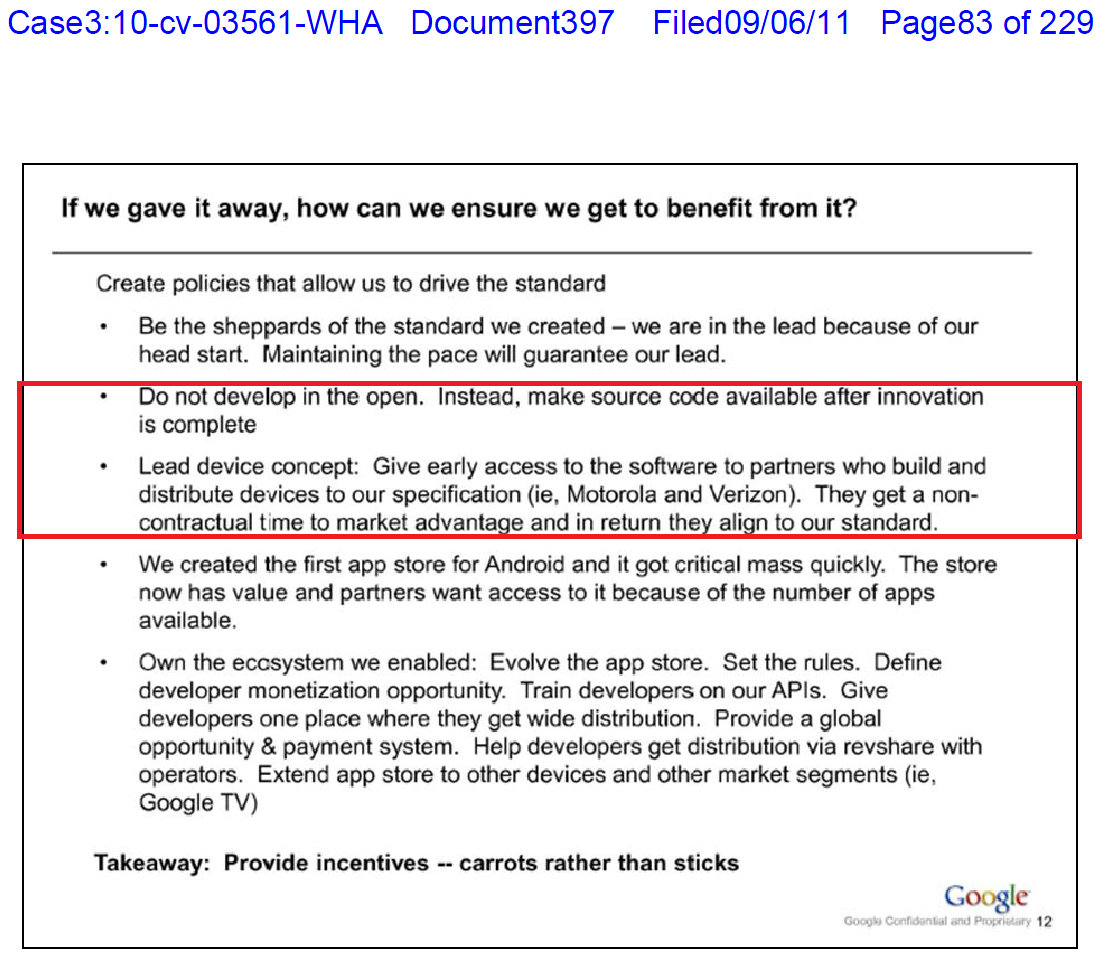
Right - and the kind of thinking embodied on that slide doesn't inspire much confidence in their motives. i.e. they aren't being open because they believe it's good for everyone. They seem to intend it as a Trojan horse that will give them control over other people's products.
It's apparently part of the discovery documents from one of the ongoing lawsuits Google is involved in. You know as much as I do about it now; I have no idea whether the rest is available without looking in court records.


Another example: trello.com is a very nice and free card tool for small projects, but because they wanted to avoid having an "edit" button on editable text, they hijack my clicks, so it makes it painful to select text, and quite impossible to use "middle-click as paste".
But, there is a more positive perspective liked to Google+. In fact, I think the midterm result of Google entering in the SNS arena could (and should) be to force open Facebook. I mean, right now G+ is not open, it doesn't have all the needed APIs, and this is probably OK because they they need a critical mass before opening, and one should not bash them for testing, pondering, adjusting a bit more before releasing some important changes. Time is on their side anyway.
But in the end, they will go, I hope, the full good-old Google way, which means:
- Read/write APIs for posts, followers, followees, etc.
- Ability to dump all data and go away
- RSS or similar subscribing hooks
These tools will allow a much higher interoperability for social content, similar to interoperability of emails today. Users will not really care if the comments on their baby pics are written using Facebook, G+ or any other Social Content Manager, they will read and respond to them in the SNS of their choice, like we do today with emails. (I wrote a bit more ion this topic there: https://plus.google.com/104035200377885758362/posts/A9r7twSD...)